
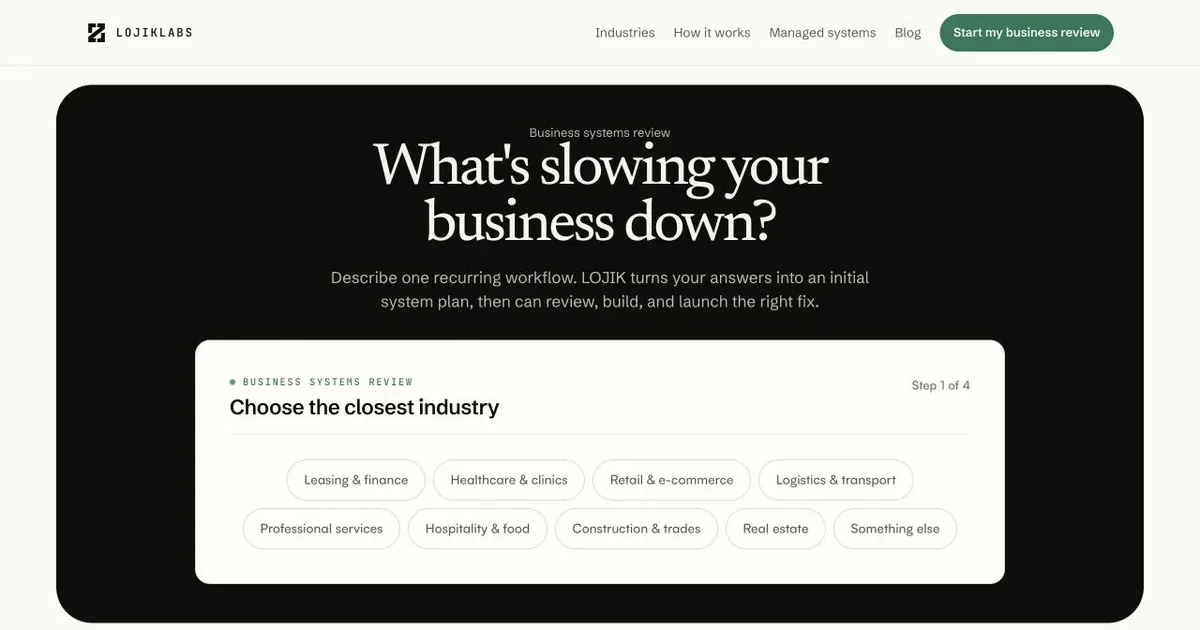
Work that breaks between tools
Recurring business work tends to fail in the space between tools: one system holds the record, another starts the action, someone re-keys the data, and nobody owns the failure.
Lojik started with a broad product-studio story. We replaced it with a narrower promise: start with one important workflow, find where it breaks, define the whole operating system around it, and build the right fix. The public site now opens with a review of one business workflow instead of a list of technologies.
What I do
As co-founder and technical lead, I work from the operating problem through to the system that delivers and maintains the fix:
- Product and delivery strategy
- Workflow and system-boundary definition
- Technical architecture and hands-on engineering
- Data, integrations, permissions and external effects
- Acceptance criteria, observability and recovery
- The private evidence and operating tools behind delivery
What I built behind it
The front door asks a prospective client to describe one recurring workflow. It turns that into a first system plan with its assumptions and open questions in view, and keeps expert review between automated preparation and any commitment.
- Facts, inferences, recommendations and authority stay separate, so one can't pass for another.
- The system of record is explicit; dashboards and models never quietly become the truth.
- People approve anything involving money, commitments, permissions or customers.
- Effects are durable and idempotent wherever an interruption or replay could do damage.
- When email, models or scheduling are down, the system degrades instead of failing silently.
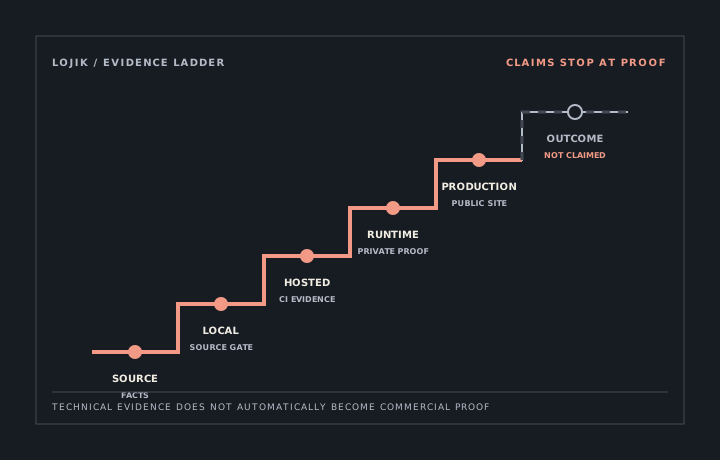
- Acceptance evidence is tied to the exact artifact and environment being claimed.
Recovery is part of delivery: provider outages, partial completion, stale state and human correction each have a defined path, written into the system before launch rather than cleaned up after it.
Evidence boundary
This is a company-building and systems-design case study. It describes the public site; internal implementation is not demonstrated here.
It claims no revenue, repeatable acquisition, finished client outcome or automation of the whole business, and it includes no private routes, credentials, customer records, proposals, contracts, payments, tax records or internal operating data.
Stack
Next.js, TypeScript, Python with FastAPI, PostgreSQL, durable workflows, policy gates and GitHub Actions.